
When the Decision Is Final Until It Isn't
In this post
What happened
A relative of mine applied for a UK Standard Visitor Visa. They live and work in North America, hold a Nigerian passport, and are in permanent employment at a multinational company. By most reasonable assessments, their application was solid. It was refused.
The refusal letter said the decision was final.
I did not accept that.
The reasons given
The caseworker cited two things: insufficient ties to their country of residence, and an inability to explain the source of funds transferred between their own bank accounts, from a current account to a savings account.
I want to be measured about what I say here, but it was hard not to read those reasons and feel that the application had not been properly assessed. Someone in stable employment, living in North America, with a clear financial trail, being told they had not demonstrated ties to where they live. The money movement flagged was routine personal banking. These are not subtle red flags. They are the kind of reasons that get attached to a refusal when someone has made up their mind before reading the evidence.
I am not saying every refusal involving an African passport holder is the product of bias. I do understand that visa systems exist to manage immigration risk, and that caseworkers are working under pressures I cannot fully see. But when a decision looks this thin on the facts, it is difficult not to wonder whether the passport itself did some of the deciding.
What I did about it
Despite what the refusal letter said, I knew an administrative review was possible. I wrote to my MP, clearly setting out what had happened, what I believed was wrong with the decision, and what outcome I was seeking. I attached supporting evidence and a signed letter of authorisation from my relative giving both me and the MP’s office permission to act on their behalf.
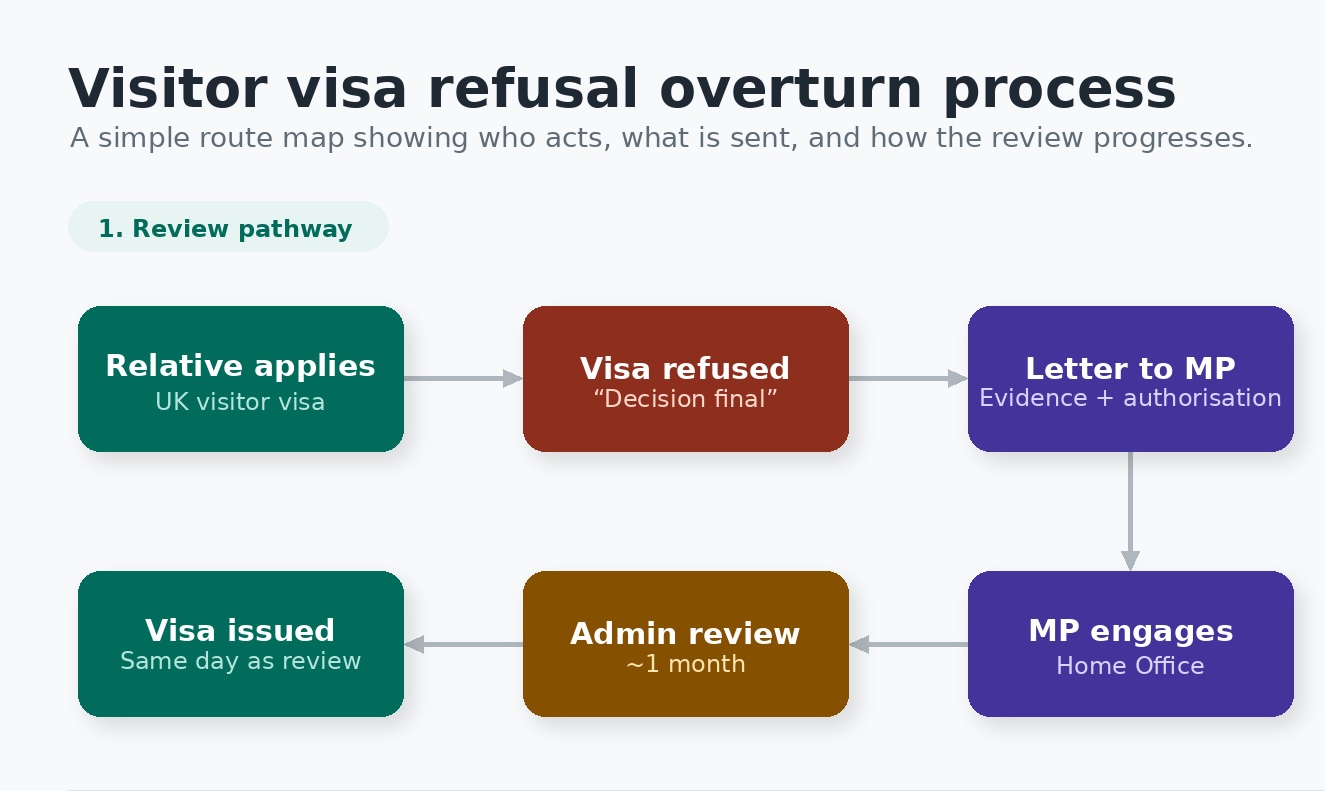
The MP’s team responded quickly and took it seriously. They engaged with the Home Office on our behalf.
What happened next
About a month later, we were told the decision would be reviewed. On the same day that confirmation came through, the visa was issued.
One month. That is all it took once someone with the right platform asked the right questions.
A few honest reflections
The first thing I keep coming back to is how outcome-dependent this whole process is on having someone to advocate for you. If my relative had no connection to the UK, no one with access to an MP, and no knowledge that administrative review was even an option, that refusal would have stood. The letter said it was final. Most people would have believed it.
The phrase “rules are made for man, not man for rules” is one I have always found useful. It does not mean the rules do not matter. It means that rules exist within a system built by people, and that system can respond to a well-made case. What I learned here is that this is true in practice, not just in theory, but only if you know where to push and have the means to do it. That is a significant caveat.
The second thing I keep thinking about is what it costs people to prove themselves in this way. My relative is employed, financially stable, and has clear reasons to return home after a visit. None of that should have needed a month of advocacy and an MP’s intervention to be taken seriously. The administrative review process exists precisely because initial decisions are sometimes wrong, but getting to that process requires knowing it exists, having the documentation ready, and finding someone willing to help move it forward. That is not a system designed to be accessible.
I do not think the answer is to abandon scrutiny at the border. But I do think there is a version of this where caseworkers engage with applications on their actual merits rather than on pattern-matching that substitutes for proper assessment. That version would produce fewer situations like this one.
For anyone reading this who has faced something similar: the decision being marked as final does not always mean it is.