
Applying for ILR: How-to-series

In this post
- Getting there
- Working out your qualifying period
- The covid concession that mattered
- What you actually need to gather
- The 180 day rule and your travel history
- The cover letter
- After ILR is granted
Getting there
I’ve now been granted indefinite leave to remain. This post walks through how I approached the application, including the parts I had to work out for myself, in case it helps someone going through the same thing.
Quick disclaimer: I am not an immigration lawyer, immigration adviser, or Home Office expert. This is not legal advice. I am only sharing my own experience and how I understood the guidance at the time I applied. Immigration rules and guidance can change, and your circumstances may be different, so please check the official Home Office guidance and get qualified advice if you need it.
Working out your qualifying period
The first thing to pin down is your qualifying period, and it’s worth slowing down here rather than assuming. It depends on when you first got your skilled worker visa, and it’s defined in the Home Office settlement caseworker guidance — not the summarised versions floating around online. Read the actual guidance; the detail matters.
In broad terms, the qualifying period is the stretch of time that legally counts towards the five (or ten) year period required for settlement. I applied under the five year skilled worker route, and I’ll use my own situation to show how I worked out the start date.
For most people who applied from outside the UK, the qualifying period starts from the date they were stamped in, or the date the visa was approved. That’s the general rule — but cross-check it against your own circumstances, because mine didn’t follow that pattern.
The covid concession that mattered
My start date turned out to be the date I applied for my first skilled worker visa in-country, not a later stamp-in date.
During the covid period there was a concession: anyone in the UK on a visa — including a visitor visa — could switch to a skilled worker visa without leaving the country, and the date of the online application counted as the qualifying-period start date. The concession applies where the application was:
- for permission to stay;
- made between 24 January 2020 and 30 June 2021 (inclusive);
- supported by a Certificate of Sponsorship on the date of application; and
- made while you held valid UK permission (including as a visitor).
This is set out in the Skilled Worker caseworker guidance, in the section on the COVID-19 concession — worth reading in full and including the relevant page as an exhibit.
In my case the application fell on the final day of that window, which became my start date. Five years from that date set my qualifying-period completion, and you can apply for ILR up to 28 days before it. I submitted within that 28-day window.
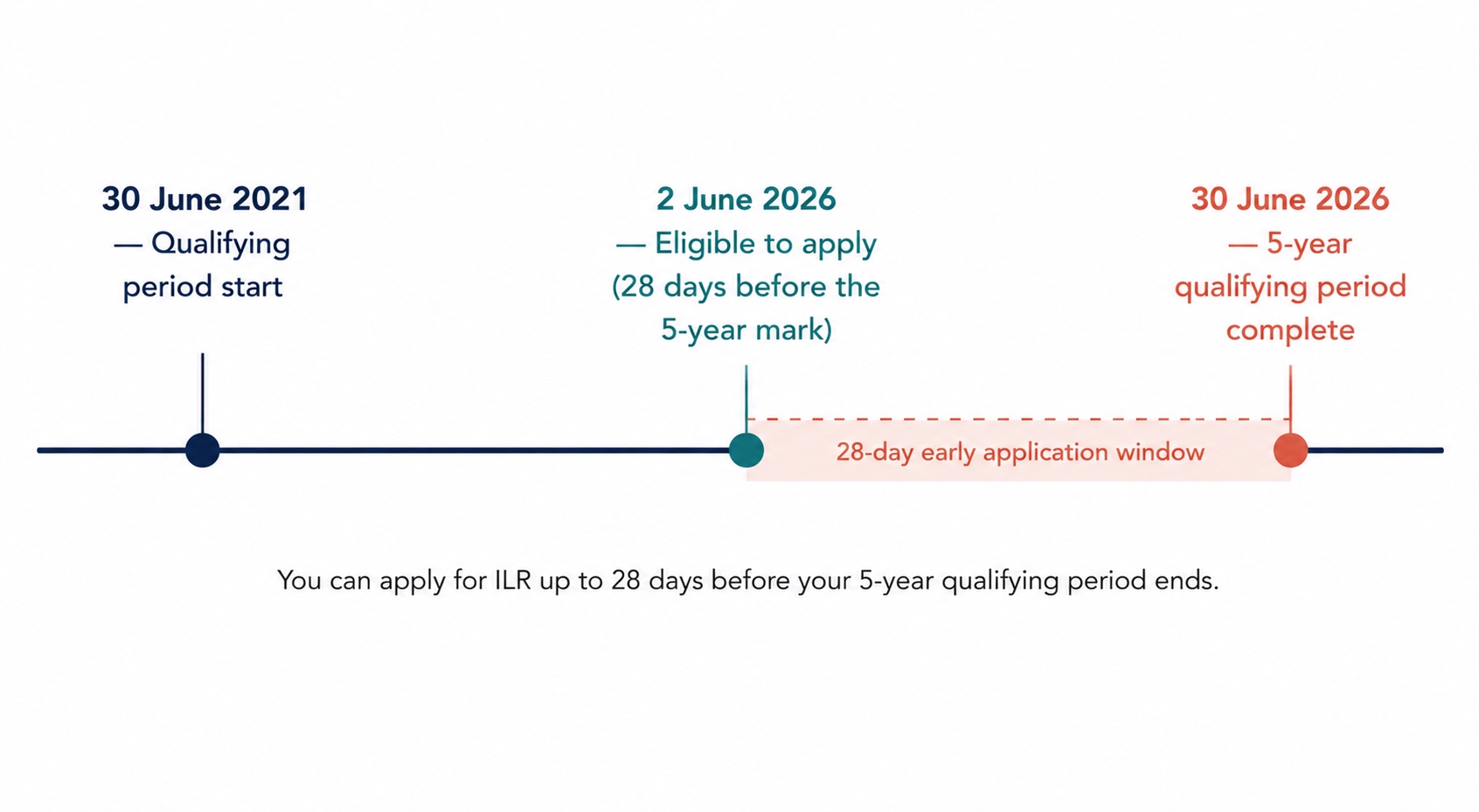
I’m including this detail not because your dates will match mine, but because a single concession — easy to miss if you only skim the general guidance — can shift your start date entirely. If your visa history includes any in-country switch around the covid period, check it properly.
What you actually need to gather
If you’re in a training post sponsored by NHS England, there’s a specific set of documents to put together.
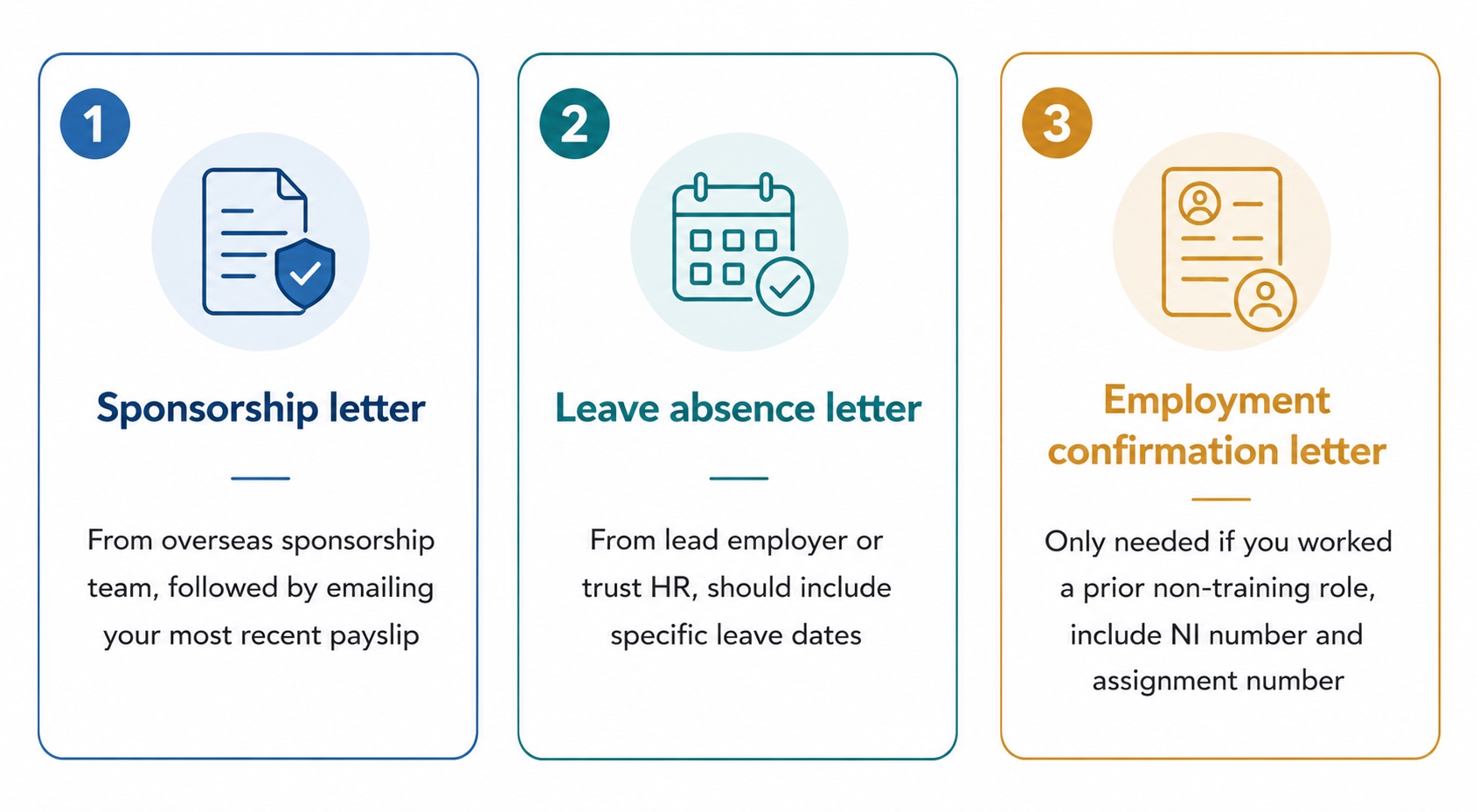
You’ll need a letter from the overseas sponsorship team confirming you’re still needed for your role. You can request it here. After you submit the form, they’ll ask for your most recent payslip.
You’ll also need a letter of absence from your employer. If you’re under a lead employer arrangement it comes from them; otherwise it usually comes from your trust’s HR department.
If you worked in a non-training role with a different employer during part of your qualifying period, request a separate employment confirmation letter from them.
Here’s roughly what I sent:
Dear Employment Services,

My name is [Your Name] and I worked as a doctor at the Trust from [start date]
to [end date]. I'd be grateful for an employment confirmation letter for
Indefinite Leave to Remain application purposes.

During this period I worked as a [role].

I've attached sample payslips reflecting my roles and assignment numbers to
assist with verification if required.

NI: [your NI number]
DOB: [your date of birth]
Assignment number: [your assignment number]

Many thanks,
[Your Name]
Trusts handle these requests regularly, so a clear request usually comes back with a comprehensive letter including your leave dates, without needing to chase.
The 180 day rule and your travel history
This is the part I’d flag most strongly. You can’t have spent more than 180 days outside the UK in any rolling 12-month period within your qualifying period — and what catches people out is assuming the employer’s absence letter covers this.
It doesn’t, necessarily. An absence letter reflects approved leave, but that doesn’t always match your actual travel dates. You might travel after a run of nights, on zero days, over a weekend, or for a study-leave conference — none of which may appear in that letter.
Instead, build your own table of every trip outside the UK during the qualifying period:
date out, date in, destination, purpose of travel
1 Mar 2023, 14 Mar 2023, Spain, Holiday
You’ll be asked for this on the ILR form itself, so have it ready rather than reconstructing it under time pressure. I used passport stamps and old travel tickets to corroborate my dates rather than relying on memory.
The cover letter
I wrote a cover letter to guide the caseworker through the application logically, rather than leaving them to piece together the qualifying period, the concession and the supporting documents. It lays out a timeline of immigration and employment history, the qualifying-period reasoning, the absences, and an index of every enclosed document. I think it made the application much easier to follow. Link to template cover letter.
After ILR is granted
If you’re in a training post, there’s one more step once ILR comes through: update overseas sponsorship using this form. Small, but easy to forget once the relief sets in.
All the best with your application.